Cookievoorkeuren
We gebruiken cookies om de website te analyseren zo dat we verbeteringen kunnen aanbrengen. Door op Toestaan te klikken, stem je in met analytische cookies.
In a three-phase installation where the main load consists of a balanced three-phase consumer (such as an electric motor) and the neutral conductor is only used for a very small current for control, monitoring, or signaling purposes, the risk of a dangerous neutral point or potential shift is negligible.
The neutral conductor generally does not need to be switched when:
no neutral conductor is connected
there is no neutral current or only a negligible neutral current
no neutral point shift can occur via the neutral conductor
the main load consists of a balanced three-phase consumer.
In these situations, a 3-pole switch that only switches L1, L2, and L3 is generally sufficient.
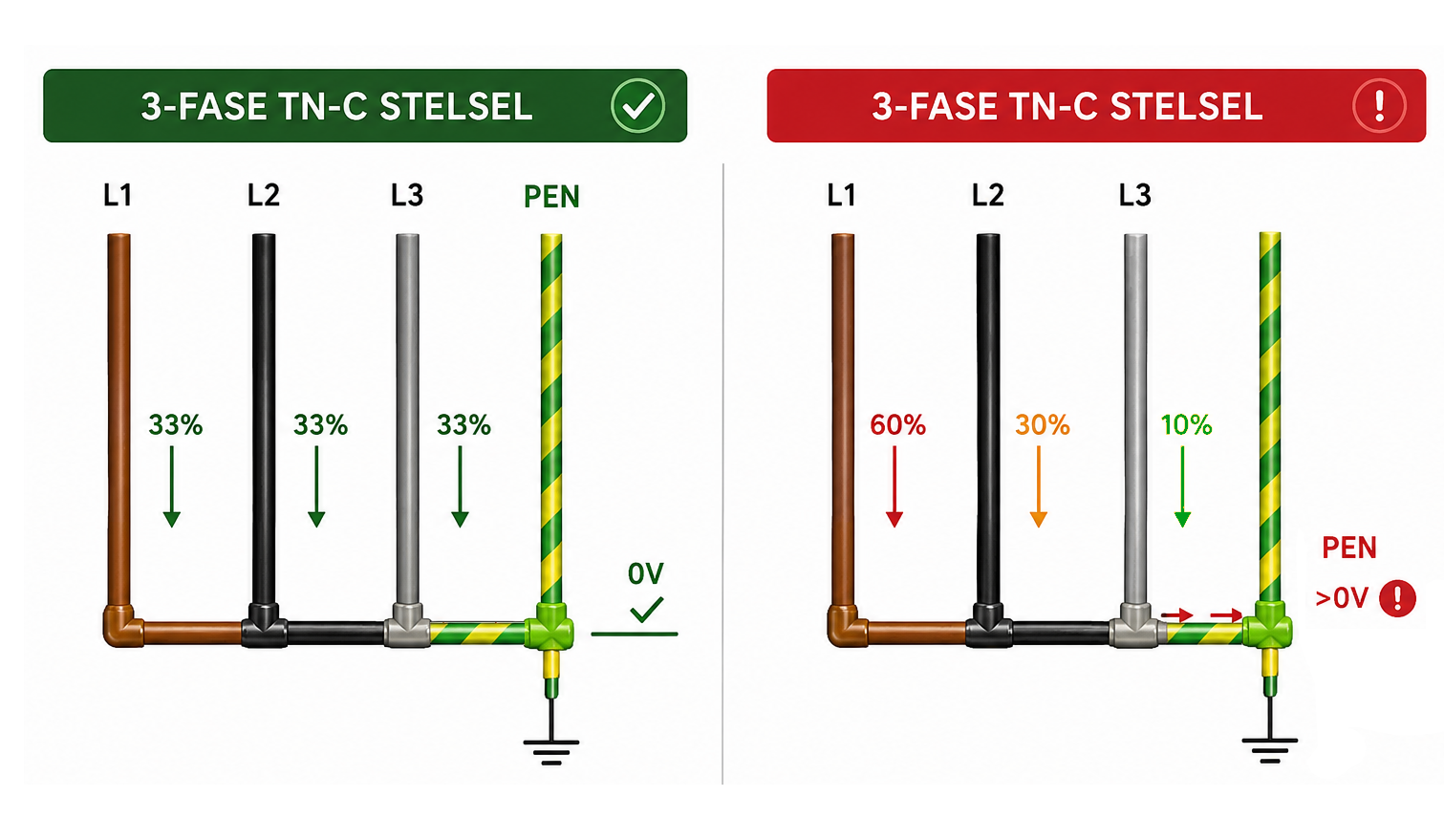
When an installation is connected to a three-phase system with a neutral conductor and the load is unbalanced, a significant current flows through the neutral conductor. If the neutral conductor is interrupted, a neutral point or potential shift may occur.
This can result in:
unequal voltage distribution across the phases
too high or too low voltage on connected 230 V loads
malfunctions or damage to equipment
hazardous situations within the installation.
To prevent this risk, the neutral conductor is switched simultaneously with the phase conductors.
A 4-pole switch (L1, L2, L3, and N) is therefore used when:
a significant neutral current is present
many 230 V loads are connected
the load is unevenly distributed across the phases
electronic equipment, lighting, or control systems are sensitive to voltage deviations.
Balanced three-phase load without a neutral conductor. → No neutral switching required.
Only a small neutral current for control/monitoring. → No neutral switching required.
No risk of neutral point shift. → No neutral switching required.
Unbalanced load with neutral current. → Neutral switching required.
Many 230 V loads connected. → Neutral switching required.
Risk of potential shift. → Neutral switching required.
Sensitive electronic equipment present. → Neutral switching required.
No or negligible neutral current → A 3-pole switch is generally sufficient. Significant neutral current and risk of a potential shift → Use a 4-pole switch including the neutral conductor.
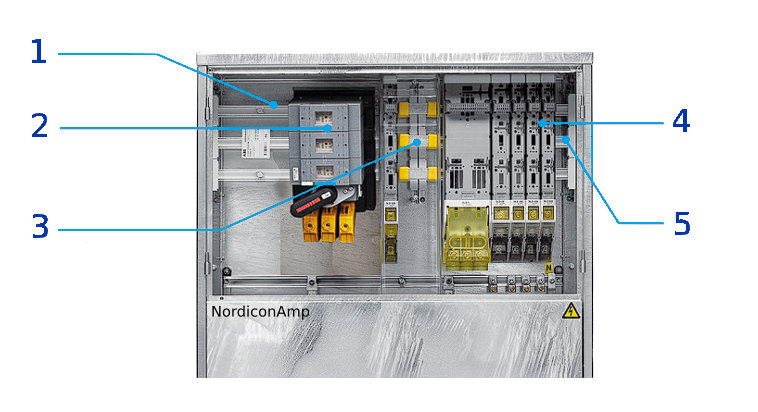
For battery and charging systems, the steel enclosures from NordiconAmp are the preferred choice. Due to the high power levels involved in these installations, considerable heat is generated. A steel enclosure dissipates heat much more effectively than a polyester enclosure, resulting in lower internal temperatures and improved reliability, service life, and operational performance of the components.
Especially in applications with high charging and discharging currents, power electronics, inverters, and battery packs, a steel enclosure is therefore recommended over a polyester alternative.
In addition, Scope inspections are placing increasing emphasis on heat generation, thermal management, and the thermal load of components and enclosures. Effective heat dissipation not only extends the lifespan of the installation but also reduces the risk of failures, accelerated ageing, and fire hazards.
High power levels and significant heat generation → Use a steel enclosure.
Installations with battery storage, EV charging infrastructure, and power electronics → Preferably use a steel enclosure.
During Scope inspections, special attention should be paid to proper thermal management.
For battery and charging systems, NordiconAmp steel enclosures are recommended due to their superior heat dissipation, greater robustness, and better thermal properties compared to polyester enclosures.

NordiconAmp levert elektrotechnische verdeelkasten en gerelateerde systeemoplossingen in samenwerking met Kabeldon en ABB.
NordiconVolt
© 2026 NordiconVolt BV. All rights reserved.